Graded or Sealed? Two Ways to Collect Japanese Cards
Walk into any serious Japanese card collection and you will usually find two kinds of objects. On one shelf, single cards locked in clear plastic slabs, each with a grade and a serial number. On another, untouched booster boxes still in their factory wrap. Both are ways of owning the same hobby, but they reward very different instincts.
A graded card is a finished story: one card, examined by a third party, given a number and sealed for good. A sealed box is an unfinished one: nobody knows what is inside, and that uncertainty is exactly where its value comes from.
This guide walks through both paths for Japanese cards (Pokémon, One Piece, Dragon Ball, Yu-Gi-Oh! and the rest): how grading works, what “sealed” really means, how the two compare, and how to look after whichever you choose.
Inside the slab: how a graded card earns its number
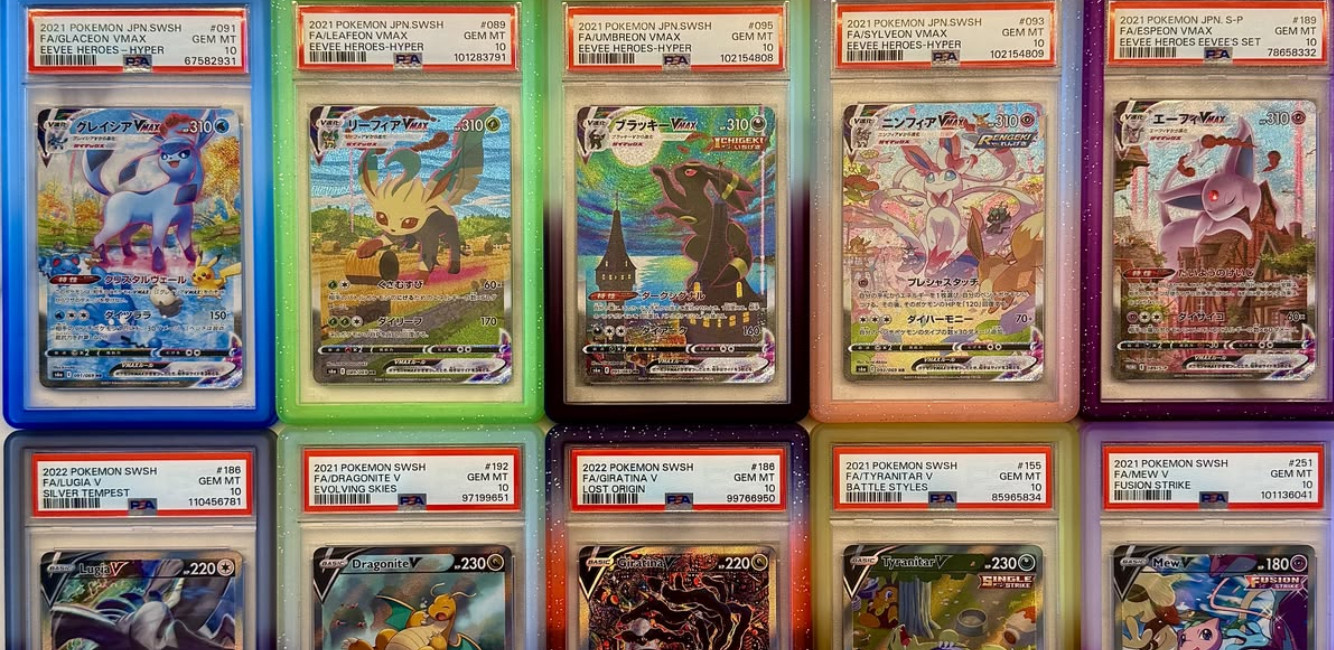
PSA (Professional Sports Authenticator) is the best-known grading company in the world and has been grading cards since 1991. Its process has three steps, always in the same order:
- Authentication. The card is checked to confirm it is genuine. Only an authentic card moves on.
- Grading. Its condition is scored on a scale from 1 to 10, with 10 being the best.
- Encapsulation. The card is sealed in a tamper-evident plastic case. The label shows the card, the grade and a unique certification number.
A PSA 10 (Gem Mint) is, in PSA’s own words, a virtually perfect card: sharp corners, sharp focus, full original gloss and no staining. Centering counts too. For a 10, the front can be off by no more than roughly 55/45 to 60/40 (PSA grading standards). That is why the gap in price between a 9 and a 10 of the same card can be large: a tiny shift in the print can decide it.


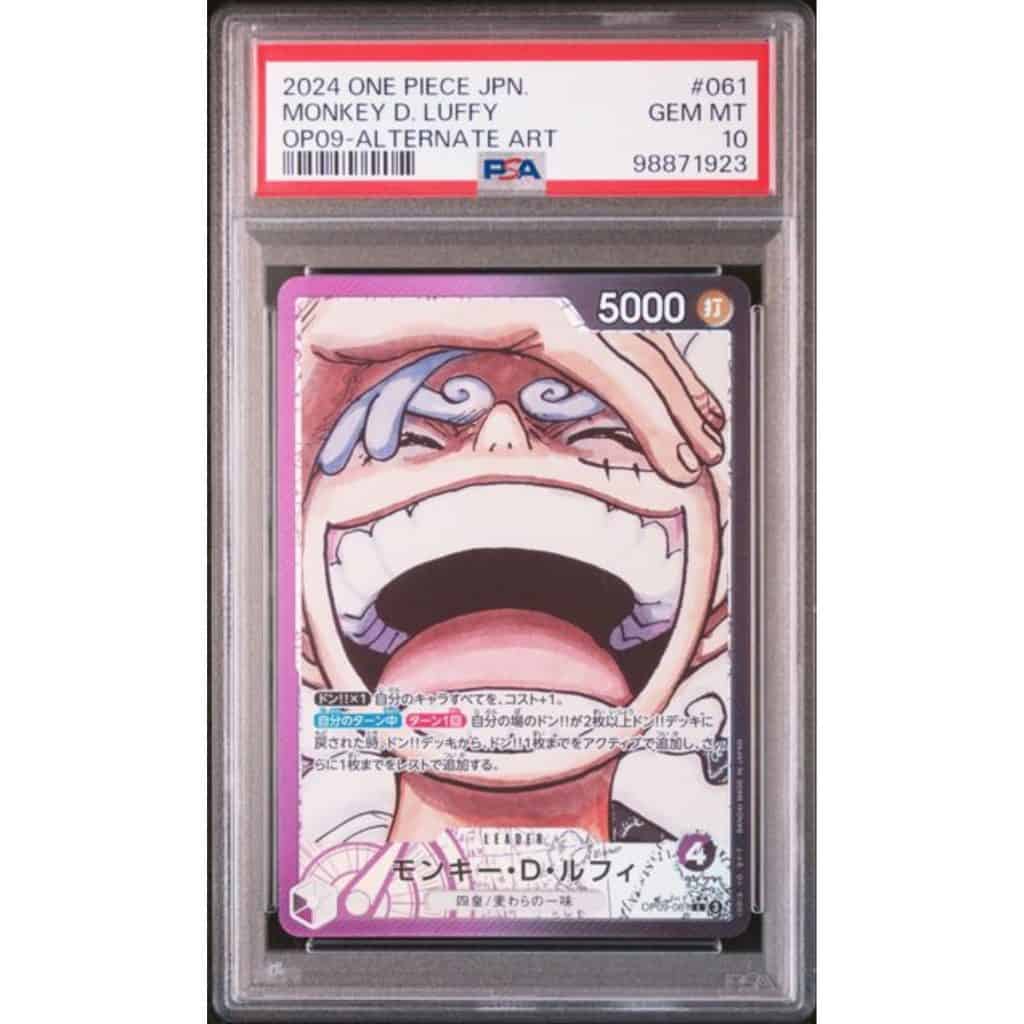
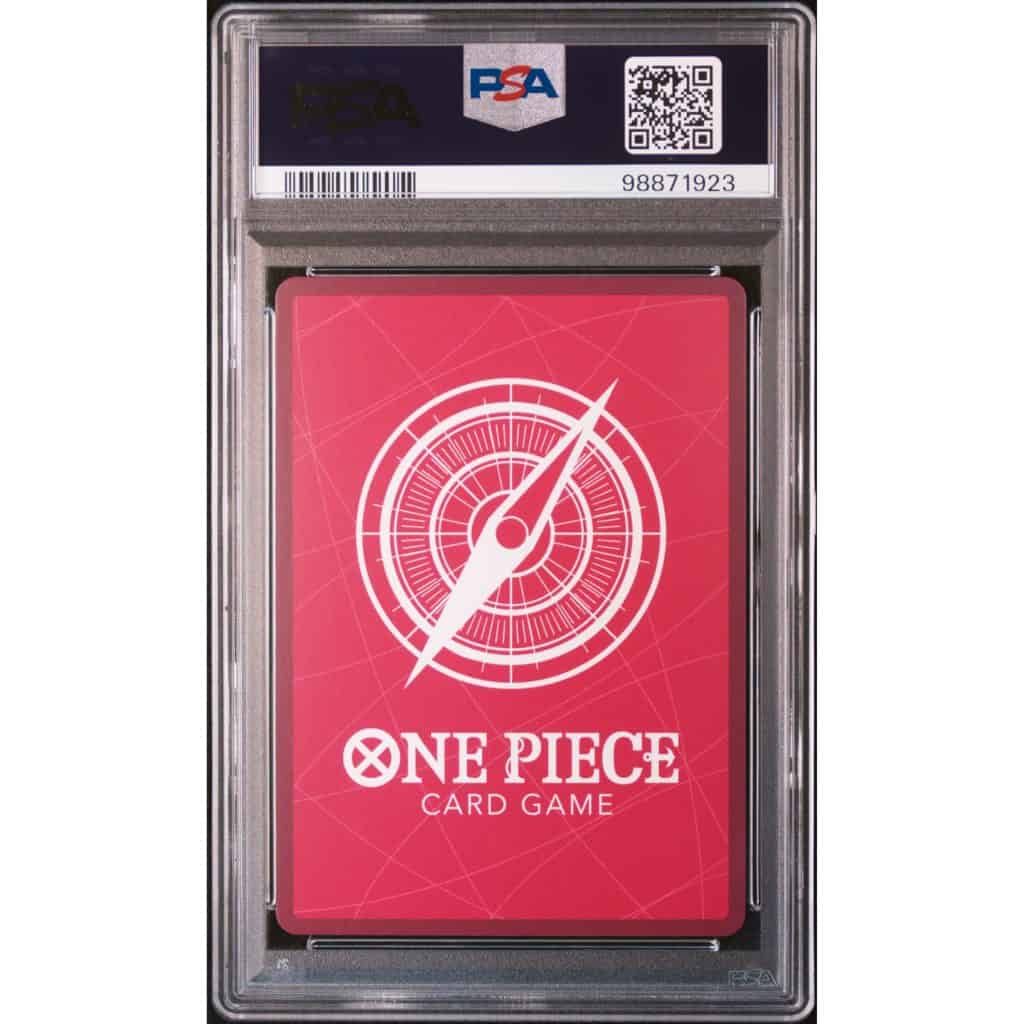
2024 One Piece Japanese OP09 – Emperors in the New World #061 Monkey D. Luffy (Alternate Art) – PSA 10
The Monkey D. Luffy #061 Alternate Art card from the 2024 Japanese One Piece Card Game OP09: Emperors in the New World set shows a bold and detailed illustration of the series’ main character. This alternate art version gives Luffy a new look, making it a popular choice for collectors and One Piece fans.
Not every slab carries a number. A label reading Authentic means PSA confirmed the card is real but did not grade its condition. Authentic Altered means it is real but has been modified, for example trimmed or recoloured. Always read the whole label, not just the brand on top.
The certification number is your best friend. Anyone can type it into PSA’s online cert verification or scan the label in the PSA app and see the card it belongs to. If the card in the slab doesn’t match the record, walk away.
One recent change matters for collectors here: since 15 September 2026, collectors in all 27 EU countries can send cards directly to PSA’s new grading facility in Frankfurt (PSA). Before that, grading from Europe meant shipping cards across the Atlantic and back.

Explore the full collection
Figures, art toys & limited editions — shipped across Europe from France.
The case for keeping it closed
Sealed means exactly what it says: a booster box, display or starter deck that has never been opened since it left the factory. In Japan, these boxes are mostly bought to be opened, often on the day of release. Every box that gets torn open makes the remaining sealed ones a little scarcer.
That is the core logic of sealed collecting. Once a set stops being printed, the number of closed boxes can only go down. We look at that logic in detail in why sealed One Piece TCG booster boxes matter to collectors. A sealed box also keeps every possibility alive: the chase card of the set could be in there, and only the person who opens it will ever know.
Japanese sealed product has a few traits worth knowing:
- Smaller packs, more of them. A Japanese Pokémon booster pack usually holds 5 cards, against 10 in English packs, and most main-set boxes contain 30 packs.
- Shrink wrap varies. Some Japanese boxes ship from the publisher in branded shrink wrap; others do not. Before buying, check what the original packaging of that specific product should look like.
- Condition still matters. Dented corners, torn wrap or a crushed box all lower the appeal, even if the contents are untouched.
The biggest risk with sealed product is resealing: a box opened, emptied of its best cards and wrapped again to look new. This is why where you buy matters as much as what you buy, and why the packaging details above are worth learning.
Five checks before trusting a sealed box
No single check proves a box is untouched, but together they catch most bad reseals. Take a minute with each one before you buy, or as soon as a box arrives.
- Feel the wrap. Factory shrink wrap is usually tight and even. Loose areas, bubbles or a wrap that slides around the box are a warning sign.
- Study the seams. Look at the folds and the sealed edges. Thick, melted-looking lines or uneven heat marks often point to wrap applied by hand.
- Compare with official photos. Find pictures of the same product from the publisher or a trusted retailer. Logos printed on the wrap, the position of stickers and the box colours should match.
- Check the corners and flaps. Glue marks, creases near the opening or a lid that sits slightly crooked can mean the box was opened and closed again.
- Weigh the evidence, not just the box. A price far below the market, a seller with no history or photos that hide the edges say more than any single detail.
If something feels off, ask the seller for extra photos before paying. A trustworthy seller will never mind.
Explore the full collection
Figures, art toys & limited editions — shipped across Europe from France.
Slab vs box at a glance
Neither path is better in absolute terms. They answer different questions, and this table puts the main differences side by side.
| Graded card (PSA) | Sealed box or pack | |
|---|---|---|
| What you own | One specific card, with known condition | A set of unknown cards in original packaging |
| Where value comes from | The card, its grade and how many exist at that grade | Scarcity of closed product and the chance of a chase card |
| How to check it | Cert number on PSA’s site or app | Packaging details, seller reputation |
| Main risk | Paying for a grade without checking the cert | Resealed or tampered product |
| Display | Easy: slabs stand up and stack | Bulky, but striking on a shelf |
| Storage needs | Low: the slab protects the card | Higher: boxes fear crushing, humidity and light |
| The fun part | Hunting the exact card and grade you want | The question of what’s inside, kept or opened |
Find your collector type
Most collectors lean one way without ever deciding it consciously. These four profiles may help you see where you stand.
The character hunter
You love one Pokémon, one Straw Hat or one Saiyan, and you want the best version of their card. Graded singles suit you: you choose the exact card, see the exact condition and skip the lottery of packs.
The set archivist
You care about the era, the artwork and the product itself. Sealed boxes and starter decks are your natural home, because the packaging is part of the history you want to keep.
The display builder
You want a shelf that looks good from across the room. Slabs line up neatly with clean labels, while a row of sealed Japanese boxes brings colour and scale. Many display collectors mix both.
The opener
For you, the fun is the moment the foil tears. Sealed product is still your path, just with a shorter life. A common habit: buy two boxes of the same set, open one and keep the other closed.
Mixing is not a compromise. A sealed box from a set you love next to the graded chase card from that same set tells the whole story of a release in two objects.
Looking after what you own
A slab protects the card inside, but not from everything. A sealed box protects nothing but its contents, and only if it stays in good shape. A few habits cover both.
For graded cards
- Keep slabs out of direct sunlight. UV light can fade the label and, over years, the card itself.
- Store them upright in a slab box or on a stand, not loose in a drawer where the plastic can scratch.
- Never try to open a slab. Once it is cracked, the grade no longer applies.
- Keep a list of your cert numbers. It helps with insurance and makes resale much easier.
For sealed product
- Store boxes flat or upright, but never with heavy objects on top.
- Aim for a dry room with a stable temperature. Cellars, attics and spots near radiators are the classic enemies.
- Keep light away. Japanese packaging colours fade faster than you might expect on a sunny shelf.
- Consider an acrylic case for boxes you plan to keep for years. It stops dust and protects the corners.
Frequently asked questions
Are Japanese cards graded differently from English ones?
No. PSA uses the same 1 to 10 scale and the same standards whatever the language of the card. A PSA 10 Japanese card and a PSA 10 English card met the same bar.
Is a PSA 9 a bad grade?
Not at all. A 9 (Mint) is an excellent card with only a minor flaw. It is often the smart buy: the card looks almost identical on a shelf and usually costs much less than the 10.
Can I grade cards I pull from a box I bought?
Yes. Since September 2026, collectors in the EU can send cards straight to PSA’s facility in Frankfurt. Before submitting, check each card under good light: if the centering is clearly off or a corner is soft, it may not be worth the fee.
Should I remove the shrink wrap to display a box?
Keep it on. For sealed collectors, the original wrap is part of what makes the box “sealed”. Once it is gone, there is no way to prove the box was never opened.
Does a graded card or a sealed box always gain value?
No collectible is guaranteed to go up. Prices depend on demand, the popularity of the characters and how many copies survive. Collect what you enjoy first; any rise in value is a bonus, not a promise.
Can I own both?
Of course, and many collectors do. Pairing a sealed box with the graded chase card of the same set is one of the most satisfying ways to remember a release.
Start your shelf with Rare Inventory
Whichever path you choose, the same rule applies: buy from a source you can trust, and check what you can. For a slab, that means the cert number. For a sealed box, it means the packaging and the seller.
The Trading Cards & TCG section of Rare Inventory brings both worlds together: PSA-graded cards, Japanese booster boxes and starter deck editions, all original and sealed. If you want to know how items are checked before they are listed, the How We Verify page explains the process.
Every order ships across Europe from our warehouse in France, with free shipping on orders over €200. If you are weighing that against ordering straight from Japan, our guide to the 2026 EU customs rules shows what an import really costs. And if Yu-Gi-Oh! is your game, start with five Yu-Gi-Oh! OCG mistakes European buyers make.
Slab or box, closed or opened: the best collection is the one that makes you smile every time you look at the shelf.
The Shop
Available Now at Rare Inventory
Pieces related to this article, in stock and ready to ship.

In Stock
2024 One Piece Japanese OP09 – Emperors in the New World #061 Monkey D. Luffy (Alternate Art) – PSA 10
€400
Shop Now →

100% Authentic Shipped from France Free Shipping Over €200