The Takashi Murakami Monopoly Explained: Roppongi Hills Edition (2004)
How many board games end up in Heritage Auctions? Almost none. The Takashi Murakami x Parker Brothers Roppongi Hills Monopoly does, and that tells you everything about what this object actually is: not a game, but a document of a specific cultural moment, sealed in cardboard, increasingly rare, and misunderstood by almost everyone trying to buy or sell one.
Myth #1: “It’s Just a Novelty Monopoly Edition”
First, understand the origin. Hasbro and Kaikai Kiki did not meet by accident. Roppongi Hills hosted the 2004 Monopoly World Championship, and to commemorate the event, Hasbro asked Takashi Murakami to oversee the design of a special Roppongi Hills board. This makes the Roppongi Hills Monopoly a genuine artist commission, not a marketing gimmick. Murakami did not simply license a flower motif. He shaped the visual language of the entire set.

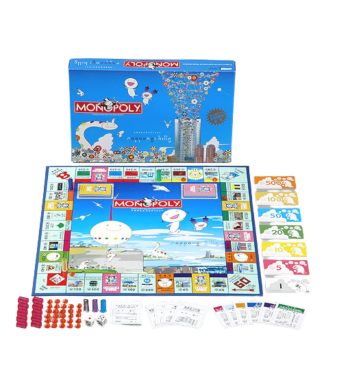
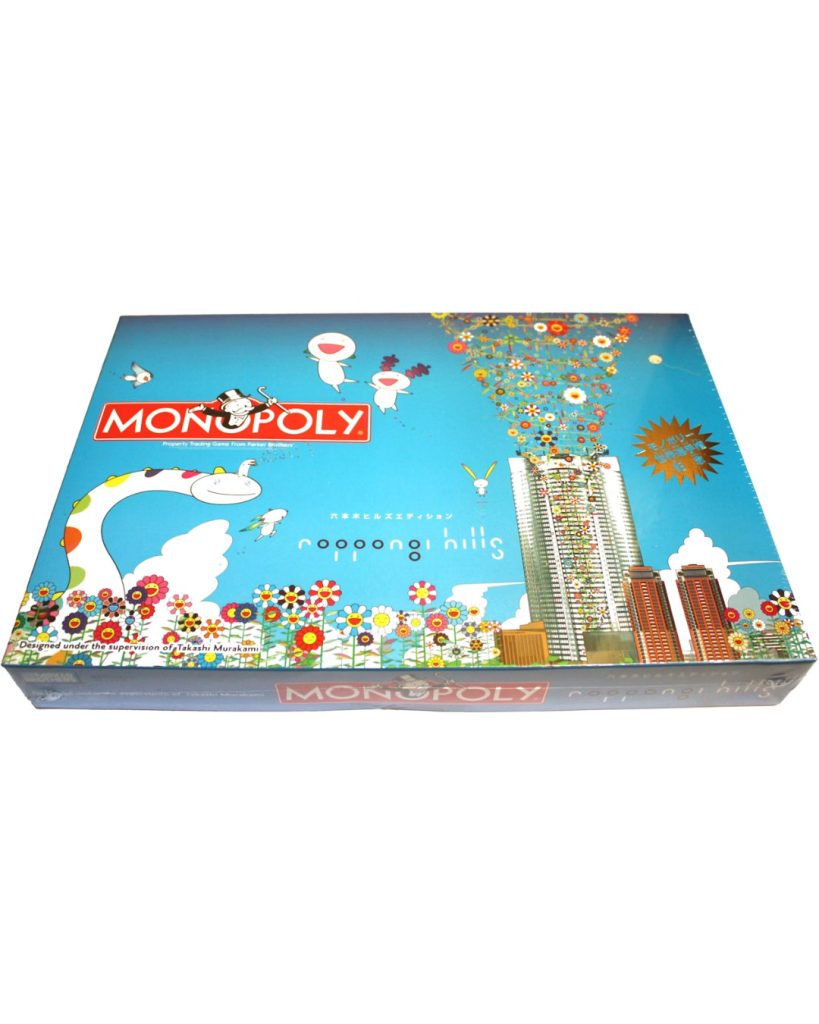
Takashi Murakami Monopoly Board Game – Roppongi Hills Edition (2004)
This is a special edition Monopoly board game produced in collaboration with Takashi Murakami for Roppongi Hills in Tokyo around 2004. The game replaces standard Monopoly properties with locations tied to the Roppongi Hills complex, and Murakami’s iconic imagery covers the board, cards, and packaging.
Moreover, the production context matters enormously. Released in commemoration of the 2004 Monopoly World Championship, this memorial version does not appear on the general market with any regularity. The game properties replace standard Monopoly real estate with Roppongi Hills landmarks: players aim to become the owner by purchasing various facilities of Roppongi Hills such as Mori Tower and Metro Hat, building kiosks and stores, and monopolizing them. That localization, combined with Murakami’s visual authorship, removes this from the “novelty edition” category entirely.
Additionally, the format itself reinforces rarity. The board game measures 10½ x 15¾ x 2 inches (5 cm) and originates from a private California collection. Units from Japanese sellers, confirmed new and sealed, carry the UPC 4547551150304, confirming a distinct Japanese market SKU. For serious Takashi Murakami collectibles hunters, that regional specificity adds provenance weight.

Explore the full collection
Figures, art toys & limited editions — shipped across Europe from France.
Myth #2: “Sealed Doesn’t Matter Much for a Board Game”
Sealed condition is everything here. Heritage Auctions confirmed their example came in the original unopened box. In the broader Murakami collectibles market, seal integrity directly determines which collector tier shows interest. Opened sets trade as curiosities. Factory-sealed sets trade as art objects.

Condition Grading: What to Look For
First, inspect the outer box corners. Murakami Roppongi Hills Monopoly boxes use a thin cardboard shell vulnerable to compression damage during two decades of storage. Second, check the shrink wrap seam, not just the face of the box. Japanese market editions use a distinctive tight-wrap style. Third, examine the box edges under UV light for water or humidity staining, common in sets stored in Japan’s humid summers. Most importantly, a pristine sealed example commands a significant premium over one with even minor box damage.
Furthermore, compare the condition premium to other Murakami collectible objects. Murakami’s broader market has seen remarkable expansion, with auction turnover growing from £480,264 in 2015 to £1.25 million in 2024, a 160% increase reflecting his rising global prominence. That macro tailwind benefits tangible collectibles like this Monopoly set directly. As a result, condition-graded examples hold value more defensibly than open, played copies.
Myth #3: “The Price Is Just About Murakami’s Name”
That argument misses the structural scarcity. The game was produced for the 2004 Monopoly World Championship in Tokyo by Takara Tomy, Japan, and these championships occur only every four years, with 40 players from around the world competing. Production runs tied to single-event commemorations are finite by design. No reissue exists. No second colorway exists. The market trades what survived intact over twenty-plus years.
How This Compares to Other Murakami Collectible Objects
| Object | Year | Format | Market Tier | Sealed Premium |
|---|---|---|---|---|
| Roppongi Hills Monopoly | 2004 | Board Game / Artist Object | Mid-High | Significant |
| Murakami Flower Go Walk Game | 2022 | Tabletop Game | Entry | Moderate |
| Murakami x Gagosian Trading Cards | 2024 | Collectible Card | Mid | High |
| LV x Murakami Vintage Bag | 2003 | Fashion Object | High | N/A |
In contrast to mass-market Murakami flower merchandise, this set occupies the intersection of contemporary art, Japanese cultural geography, and competitive game history. That three-way overlap defines a smaller, more motivated collector base willing to pay accordingly.
Beyond that, consider the trajectory of Murakami’s auction market. Lot volumes at auction surged dramatically, nearly quadrupling from 288 in 2015 to 1,058 in 2024. Still, sell-through rates held steady. Unsold rates remained consistently around 19% throughout the decade, showing extraordinary stability given the volume increase. That data confirms collector demand absorbs new supply without collapsing prices, which benefits vintage Murakami objects with fixed supply like this Monopoly set.
Explore the full collection
Figures, art toys & limited editions — shipped across Europe from France.
Myth #4: “Japanese Text Makes It Unsellable Outside Japan”
This myth costs sellers real money. The Japanese-language set is precisely what Western collectors want. Complete Murakami Roppongi Hills Monopoly sets exist in Japanese, and that authenticity signals they ship from original Japanese market inventory, not grey-market reprints. For Takashi Murakami collectors in Europe and North America, the Japanese text confirms geographic and cultural authenticity.
Similarly, consider how the vintage Louis Vuitton x Murakami market operates. Collectors actively seek Japanese domestic market pieces because those provenance markers add legitimacy. The same logic applies here. In fact, Western buyers pay a premium for unmodified Japanese domestic editions of Murakami objects across categories.
Most importantly, Murakami’s global commercial momentum continues accelerating in 2026. His recent Doraemon works sold for approximately 660 million Korean won at auction, and new wearable collaborations like the Ohana Hatake Full-Bloom Rainbow slippers demonstrate consistent cross-category demand. That momentum raises the floor for all authenticated vintage Murakami collectibles, including this Monopoly set.
Myth #5: “Any Complete Set Is a Good Buy”
Completeness requirements for this set are stricter than most buyers realize. A proper example includes the custom Murakami-designed board, all property cards featuring Roppongi Hills locations, the full set of playing tokens, paper money, title deed cards, and the original Japanese instruction booklet. However, many circulated examples surface missing tokens or with replacement money. Those sets trade at a heavy discount and carry poor long-term prospects.
Buyer Checklist Before Purchase
- Confirm all playing tokens are present and original to the set
- Verify the Murakami-designed board shows no creasing or delamination
- Check that property cards carry the correct Roppongi Hills location names in Japanese
- Inspect the box base for humidity warping, especially on Japanese domestic copies
- Request photographs of the shrink wrap seam if purchasing a sealed example
- Confirm the instruction booklet is present for complete sets
| Condition | Sealed? | Complete? | Collector Grade |
|---|---|---|---|
| Pristine | Yes | N/A | Top Tier, museum-quality hold |
| Near Mint | No | Yes, all components | Strong, display-worthy |
| Good | No | Yes, minor wear | Entry-level, volatile resale |
| Incomplete | No | Missing tokens or cards | Avoid for investment purposes |
More Takashi Murakami Collectibles at Rare Inventory
For collectors building a serious Murakami collection beyond this Monopoly set, Rare Inventory carries several authenticated pieces worth considering. The Louis Vuitton x Takashi Murakami MNNK JP The Wavy Vinyl Sealed Trading Cards (€130) represent the Takashi Murakami collectible trading card market at its most crossover-driven. The World Tour Tokyo Series Topps Trading Cards Box Set Takashi Murakami MLB anchors the Tokyo Series chapter of Murakami’s sports collaboration run. Additionally, the Spark 2022 Lewis Hamilton x Takashi Murakami Collaboration Miniature Helmet proves Murakami’s cross-sport appeal, and the Takashi Murakami 108 Flowers Revised Towel (€20) offers an accessible Murakami flower entry point for new collectors.
Where to Buy the Takashi Murakami x Parker Brothers Roppongi Hills Monopoly
Rare Inventory, based in France, specializes in authenticated Murakami collectibles and ships across Europe to serious collectors. For current availability of the Roppongi Hills Monopoly or related Murakami objects, visit rareinventory.com and browse the curated selection directly. Rare Inventory’s team verifies condition and provenance before listing, giving buyers the confidence the secondary market rarely offers on a piece this specific.
Frequently asked questions
Who is Takashi Murakami?
Takashi Murakami is a Japanese contemporary artist born in 1962 who founded the Superflat movement, collapsing the boundaries between fine art, otaku culture, and commercial design. He operates Kaikai Kiki Co., his production and artist management studio, and has produced collaborations across fashion, music, gaming, and sports. His work commands auction results from a few hundred dollars for entry-level prints up to millions for major paintings and sculptures.
Why is Takashi Murakami famous and important?
Murakami redefined what Japanese contemporary art could mean internationally. He bridged the gap between gallery fine art and streetwear culture, collaborating with Louis Vuitton, Kanye West, and Pharrell Williams while simultaneously exhibiting at major institutions worldwide. His Superflat theory gave Western critics a framework for understanding postwar Japanese visual culture, and that intellectual rigor underpins why collectors treat his limited objects, including the Roppongi Hills Monopoly, as documents of art history rather than merchandise.
Is Takashi Murakami famous in Japan?
Yes, though his domestic reputation differs meaningfully from his Western reception. Japanese collectors historically approached his work through the lens of the otaku subculture he references, while international collectors came through the fine art establishment. His collaboration with Roppongi Hills, one of Tokyo’s premier cultural and commercial developments, reflects his genuine standing within Japan’s cultural infrastructure. The 2026 Doraemon auction result of approximately 660 million Korean won confirms continued East Asian institutional appetite for his work.
Is Takashi Murakami still alive?
Yes. Murakami was born in 1962 and remains actively producing work in 2026. His studio Kaikai Kiki continues releasing new collaborations across multiple categories, from footwear to trading cards to fine art prints. This ongoing creative activity sustains market interest in his vintage pieces, including the 2004 Roppongi Hills Monopoly, because new collectors entering his universe consistently discover the historical archive.
The Shop
Available Now at Rare Inventory
Pieces related to this article, in stock and ready to ship.


In Stock
Takashi Murakami Hikaru Flower Cushion 30 cm (Black & Gold) | Kaikai Kiki
€155
Shop Now →100% Authentic Shipped from France Free Shipping Over €200