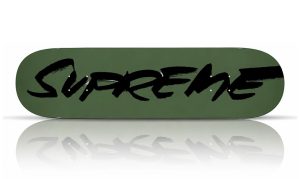

Skate Decks as Art: Collectible Boards Worth Framing
The skate deck is no longer just a piece of maple wood destined for a skatepark. Over the past three decades, it has evolved into one of the most compelling and undervalued canvas formats in contemporary art collecting. From Supreme’s early collaborations with Damien Hirst to Takashi Murakami’s flower-drenched graphics, the collectible skate deck sits at a precise intersection of street culture, fine art, and speculative investment. Serious collectors know this. The broader market is still catching up.
This guide covers everything you need to make informed decisions: authentication, grading, storage, market dynamics, and the key artists whose boards belong on your wall, not under your feet.
The History of the Skate Deck as Collectible Art
From Functional Object to Gallery Piece
Powell Peralta launched the first wave of graphic-driven deck culture in the 1980s. Artists like VCJ (Vernon Courtlandt Johnson) created the iconic Skull and Sword graphic, which immediately transcended sport. However, the real pivot came in the mid-1990s when Supreme began commissioning fine artists, treating the deck shape as a legitimate print medium. That decision changed everything.
By the early 2000s, Japanese artists and brands had fully adopted the format. Murakami, KAWS, and Futura all recognised the deck as a portable, affordable, and culturally loaded collectible. Additionally, the limited production runs typical of skate culture mapped perfectly onto the scarcity mechanics that drive serious collector markets.
Why the Format Works as Art
The 8-inch (20 cm) by 32-inch (81 cm) shape is genuinely distinctive. It forces compositional decisions that a standard rectangular print does not. Furthermore, the concave curvature, the nose, and the tail give artists a sculptural dimension to consider. When framed properly, a quality deck commands a wall with real authority. In contrast to a poster or a giclée print, the deck carries material authenticity. You can see the wood grain through the graphic. You can feel the pressed maple layers. That physicality matters to collectors.
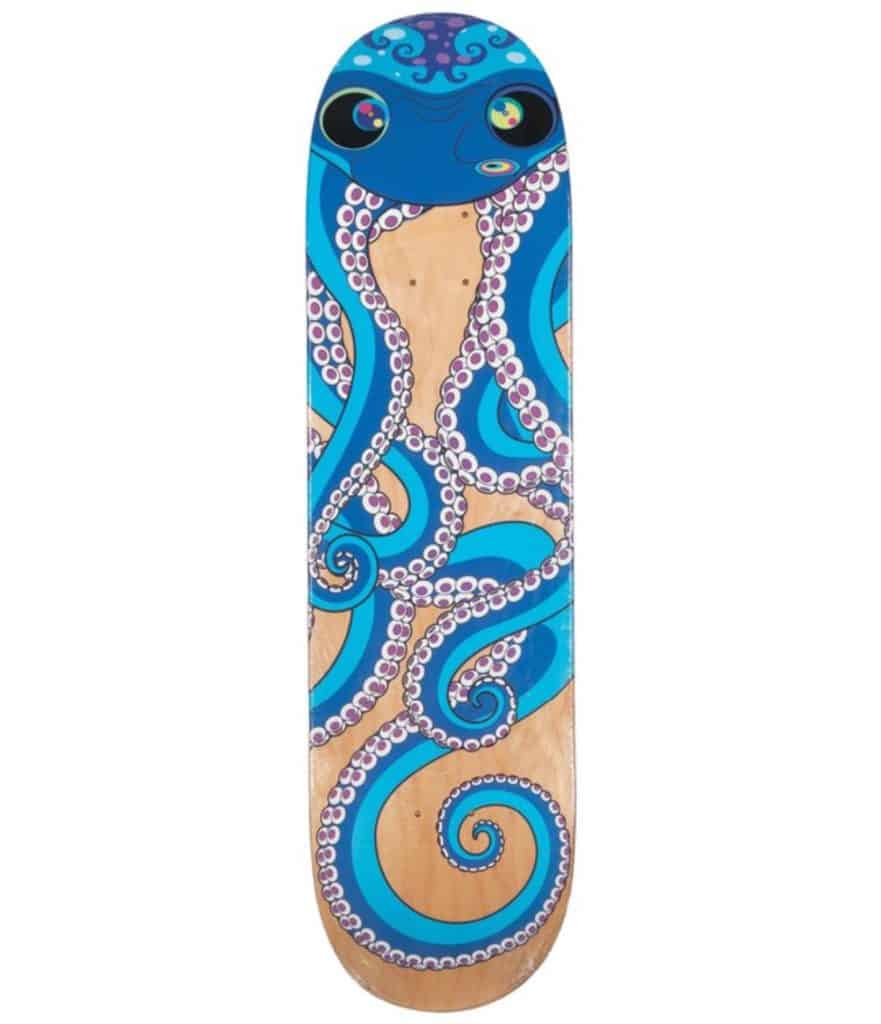
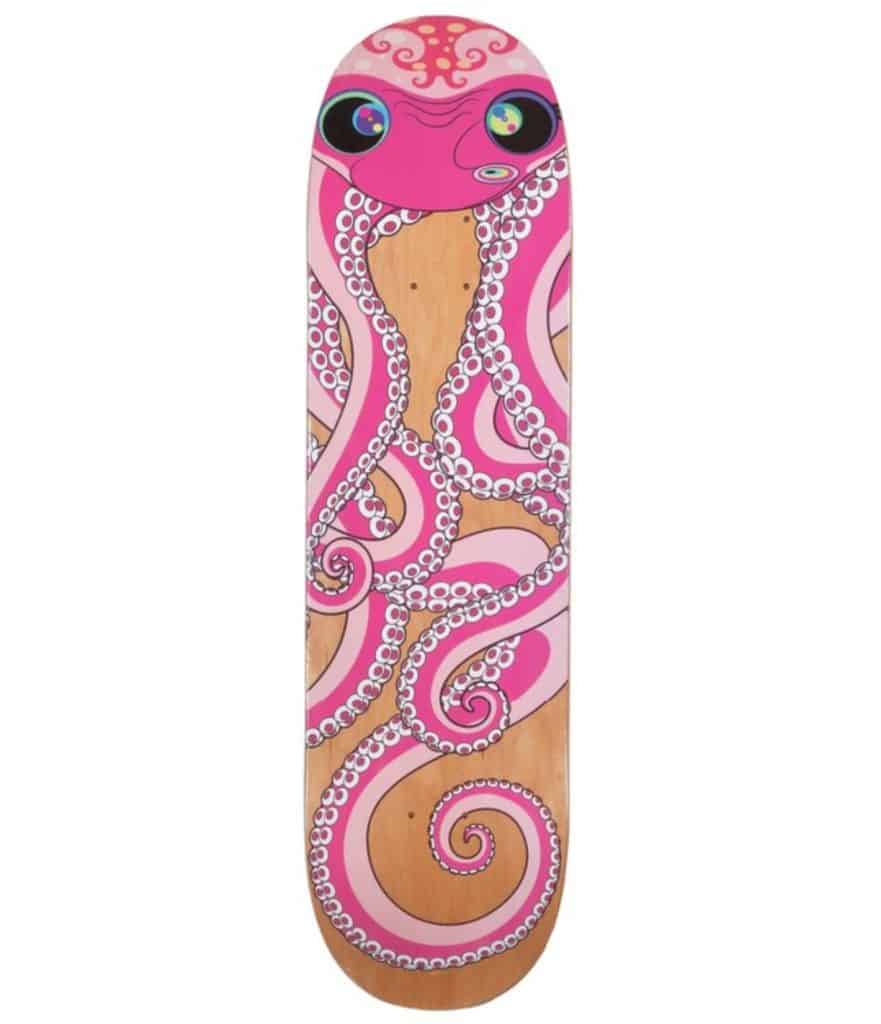
Key Artists and Their Most Important Decks
Takashi Murakami: The Blue-Chip Standard
Murakami is the most important name in the collectible deck market today. His flower motifs, developed through his Superflat theory of post-war Japanese visual culture, translate onto the deck format with startling clarity. The graphics are bold, the iconography is immediately recognisable, and the secondary market has proven consistently strong.
The Takashi Murakami x Madsaki Flower Skate Deck is one of the most compelling entry points into Murakami deck collecting. Madsaki, the New Jersey-born, Tokyo-based artist whose graffiti-inflected reworkings of Murakami’s flowers caused genuine controversy in the Japanese art world, brings a subversive energy to the collaboration. The result is a deck that feels simultaneously reverent and confrontational. For €250, this is serious value against the secondary market trajectory of Murakami collaboration pieces.
Meanwhile, the Takashi Murakami Iikoto-chan, Waruikoto-kun Skate Deck (2022) represents a different dimension of his practice. The character-based graphics reference his deeper narrative work, connecting to the broader Kaikai Kiki universe. At €150, this deck is accessible without being cheap. First-time Murakami collectors should consider this as their anchor piece.



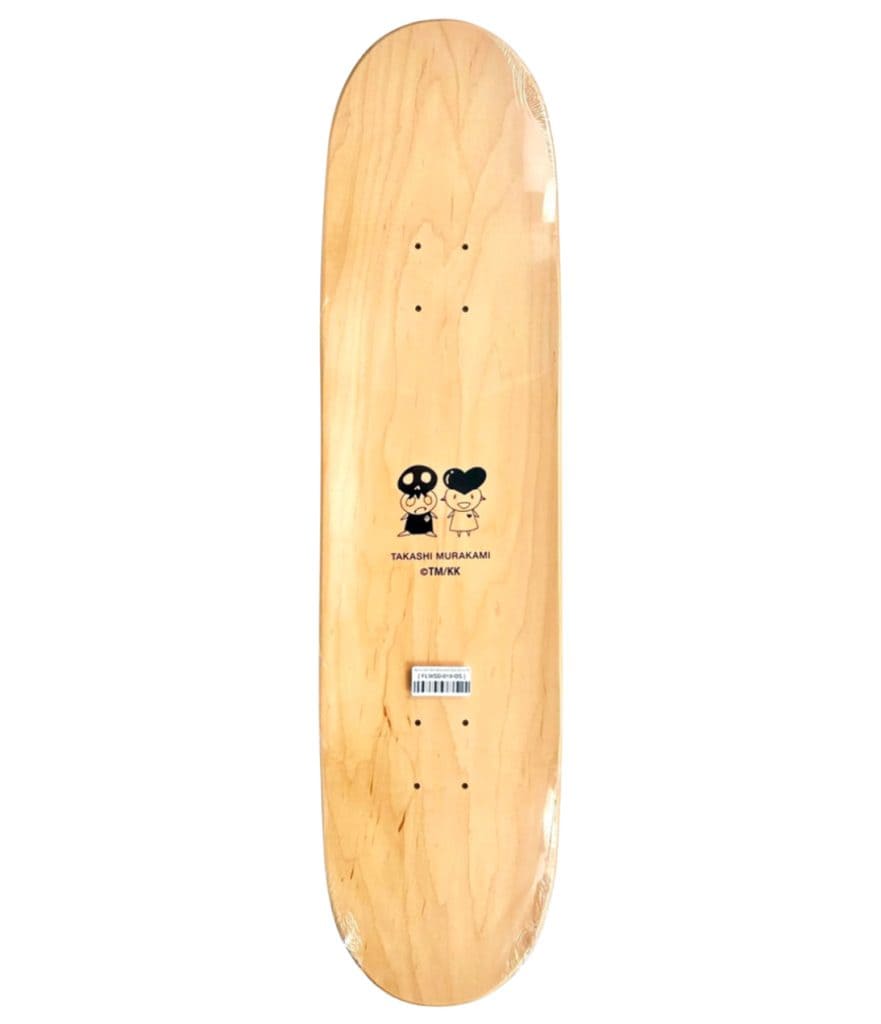
Takashi Murakami Iikoto-chan & Waruikoto-kun Skateboard Deck (2022)
The Iikoto-chan, Waruikoto-kun Skate Deck – Takashi Murakami (2022) is a vibrant collectible featuring two iconic characters by Takashi Murakami. Iikoto-chan (“good child”) and Waruikoto-kun (“bad child”) represent the contrast between innocence and mischief.
Murakami skate decks in PSA 10 condition have appreciated an average of 40-60% above original retail on the secondary market within 18 months of release, particularly on collaboration editions with verifiable print runs under 500 units.
KAWS, Supreme Collabs, and the Street Art Tier
KAWS decks from the early Supreme collaborations (1999-2004) now trade at four and five figures for sealed examples. However, even mid-period KAWS deck releases, including those produced through his own studio, hold strong. The key variable is always condition. A KAWS deck with truck holes drilled loses 70-80% of its collectible value immediately. The market is merciless on that point.
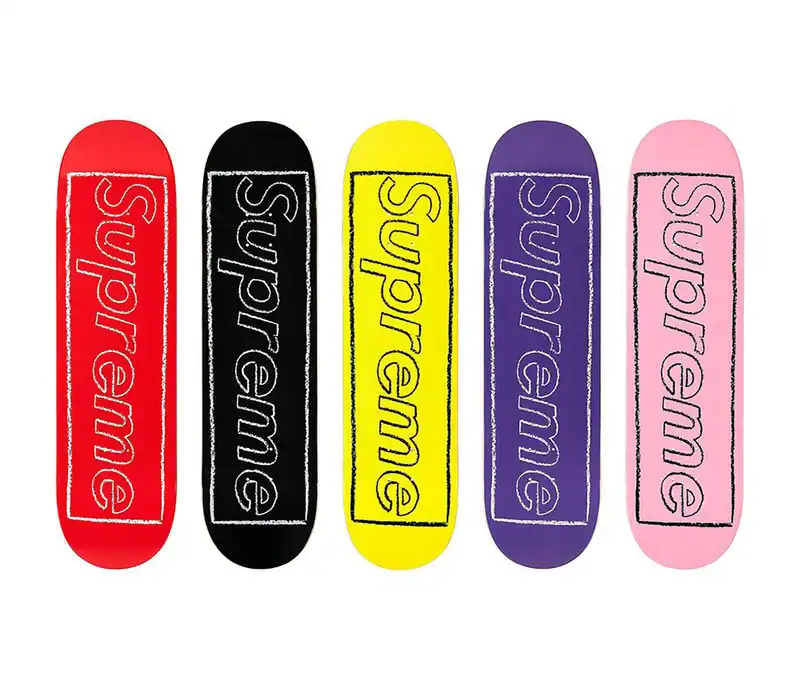
Supreme’s artist series decks, particularly those featuring Larry Clark, Richard Prince, and Jeff Koons graphics, have established auction records at Christie’s and Phillips. These are no longer skate brand products. They are fine art multiples produced in deck form. Collectors should treat them accordingly.
Emerging Artists Worth Watching
Beyond established blue-chip names, several artists are building credible deck-based practices. Hebru Brantley’s Flyboy character has appeared on limited deck runs that outperform expectations at auction. Additionally, Japanese artists connected to the Kaikai Kiki ecosystem consistently produce deck editions that gain traction in both domestic and international markets. The Japanese collector base treats deck condition with exceptional seriousness, which tends to anchor secondary prices at higher floors than Western markets alone would support.
Authentication, Grading, and Condition Standards
How to Authenticate a Collectible Deck
Authentication for high-value decks follows several key steps. First, verify the original retail packaging. Most collectible decks ship in a poly bag with a manufacturer’s label, or in a branded box. That packaging is part of the collectible. A Murakami deck outside its original packaging loses provenance and, with it, a meaningful percentage of value.
Second, examine the graphic itself. Screen-printed graphics on quality collectible decks show specific characteristics: ink sits slightly above the wood surface, colour registration is precise, and the graphic extends to consistent margins. In contrast, bootleg or counterfeit decks often show degraded colour saturation and irregular edge finishing. Third, cross-reference serial numbers or edition markings against known documented runs. For Murakami pieces, Kaikai Kiki’s official records and secondary market databases both serve as references.
Rare Inventory
Explore the full collection
Figures, art toys & limited editions — shipped across Europe from France.
PSA Grading for Skate Decks
PSA now grades skate decks, and the impact on secondary market prices has been immediate and significant. A PSA 10 designation on a sought-after deck can double or triple the price over a raw (ungraded) example in comparable visual condition. However, PSA grading for decks focuses on specific criteria: graphic clarity, surface scratches, edge wear, concave integrity, and packaging condition for sealed pieces.
Collectors submitting decks for grading should understand one critical point: PSA examines the deck without drilling, obviously, but also assesses factory imperfections that occurred during pressing and printing. A graphic misalignment that happened at the factory still affects the grade. Submit only your best examples, and store unsubmitted decks in acid-free sleeves inside rigid cases to prevent scratching during storage and transport.
| PSA Grade | Condition Description | Market Impact |
|---|---|---|
| PSA 10 (Gem Mint) | Perfect graphic, no surface wear, perfect edges | 2-3x raw value |
| PSA 9 (Mint) | Minor factory imperfection only, no handling wear | 1.5-2x raw value |
| PSA 8 (Near Mint-Mint) | Slight edge or surface imperfection | Close to raw value |
| PSA 7 and below | Visible wear, graphic damage, or drilling | Below raw market value |
Storage, Display, and Framing: Doing It Right
The Case Against Trucks
Installing trucks destroys collectible value. This cannot be stated clearly enough. Even if you never skate the deck, drilling holes signals to every future buyer that the piece was treated as sporting equipment rather than art. For display purposes, purpose-built deck wall mounts grip the nose and tail without contact drilling. Several Japanese and American manufacturers produce museum-quality acrylic deck displays that hold the board’s concave shape perfectly. These are the correct solution.
Framing for Gallery Presentation
Professional framing elevates a collectible deck from wall decoration to genuine art presentation. Use UV-protective museum glass to prevent graphic fading. Mount the deck on acid-free backing with archival foam spacers that allow the board’s concave to sit naturally without pressure. A deep shadow box frame, typically 3 to 4 inches (8–10 cm) in depth, accommodates the board’s profile without forcing it flat.
Additionally, consider the framing as a design decision in itself. A Murakami deck framed in natural maple echoes the board’s own construction material. A Supreme artist-series deck in a minimal black float frame reads as a deliberate fine art context. The framing communicates your seriousness as a collector.
Long-Term Storage Conditions
For unframed storage, maintain a consistent temperature between 60 and 70 degrees Fahrenheit with relative humidity between 45 and 55 percent. Avoid basements and attics. Wood responds to humidity fluctuations by warping, and even minor warping in a maple deck affects its PSA grade potential significantly. Store boards horizontally in rigid cases, never leaned against a wall vertically for extended periods.
Skate Deck vs. Fine Art Print: Investment Comparison
| Factor | Collectible Skate Deck | Fine Art Print (Giclée/Screen Print) |
|---|---|---|
| Entry price (blue-chip artist) | €150 to €500 typical | €500 to €5,000+ typical |
| Format exclusivity | High: deck shape is culturally specific | Medium: prints exist in multiple formats |
| Authentication complexity | Medium: PSA grading available | High: requires specialist expertise |
| Display impact | Strong: three-dimensional presence | Variable: format-dependent |
| Japanese market demand | Very high for key artists | High for established names only |
| Secondary market liquidity | High on StockX, eBay, auction | Variable: requires gallery relationships |
Rare Inventory Recommends
Editor’s Pick: If you are building a serious desk-to-wall collectible art position in 2024, the Murakami x Madsaki Flower Skate Deck is the strongest single purchase in this price range. The collaboration history between these two artists is documented, the Kaikai Kiki provenance is verifiable, and the visual impact is immediate. Buy it raw, store it properly, and consider PSA submission within 12 months. This piece will not stay at €250 indefinitely.
Where to Buy Collectible Skate Decks
Rare Inventory carries authenticated collectible decks including current Murakami editions, and ships across Europe from its base in Cannes, France. For collectors across Europe, the tracked shipping capability combined with authenticated stock makes Rare Inventory a primary source worth bookmarking. Browse the current deck selection at https://rareinventory.com/product-category/skate-decks/ for the latest available pieces.
Does skating a collectible deck permanently destroy its value?
Yes, in almost every case. Skating introduces graphic wear, edge chipping, and unavoidable drilling for truck installation. Even a single session reduces a PSA-gradeable deck to an ungraded display piece at best. The resale market treats skated decks as wall art only, not investment-grade collectibles.
How do I verify a Murakami skate deck’s authenticity?
First, check the original packaging for Kaikai Kiki co., Ltd. branding and production information. Second, examine the graphic printing quality under magnification. Third, cross-reference the edition details against Kaikai Kiki’s published records or established secondary market databases. For high-value pieces, PSA submission provides the strongest third-party authentication available.
Is the Japanese market significantly different for deck collecting?
Japanese collectors apply extremely high condition standards, which tends to elevate floor prices across the global market. Additionally, domestic Japanese releases, including the Mononoke Kyoto editions from Murakami’s practice, often carry premiums for sealed Japanese-market packaging versus internationally distributed versions. The Japanese edition frequently trades above the English equivalent for Murakami-adjacent collectibles.
What is the minimum collection size worth pursuing PSA grading for?
PSA grading makes economic sense when your deck’s estimated raw market value exceeds €200 and you have a reasonable expectation of a PSA 9 or PSA 10 outcome. Grading fees and turnaround times mean that lower-value pieces rarely justify the cost. However, for any Murakami collaboration deck in pristine condition, grading submission is almost always the right decision.
The Shop
Available Now at Rare Inventory
Pieces related to this article, in stock and ready to ship.


100% Authentic Shipped from France Free Shipping Over €200