A pre-purchase checklist for sealed Murakami puzzles
Back in 2020, when Kaikai Kiki dropped the 727 jigsaw puzzle and locked-down buyers discovered the Murakami puzzle category overnight, sellers learned something fast: most buyers had no idea what they were actually purchasing. Sealed boxes changed hands repeatedly. Wrong piece counts got listed. Repro titles snuck in beside originals. By the time collectors figured out the difference, they had already paid a premium for the wrong thing. This checklist exists so you do not repeat those mistakes.


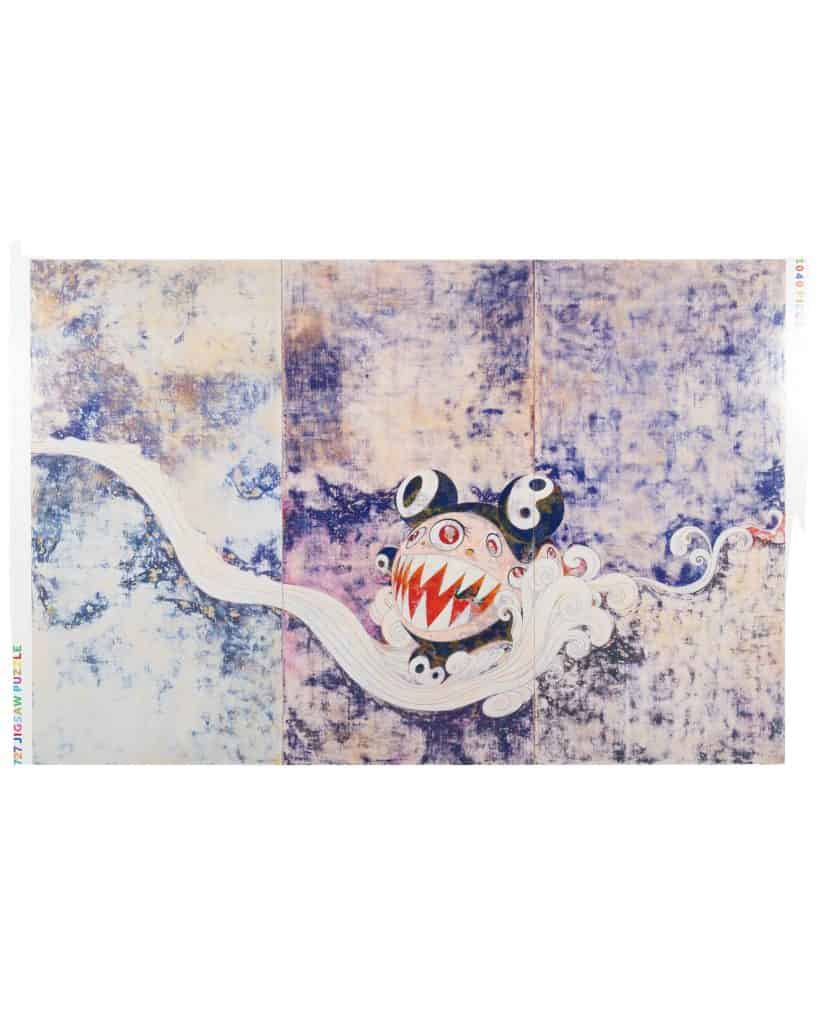
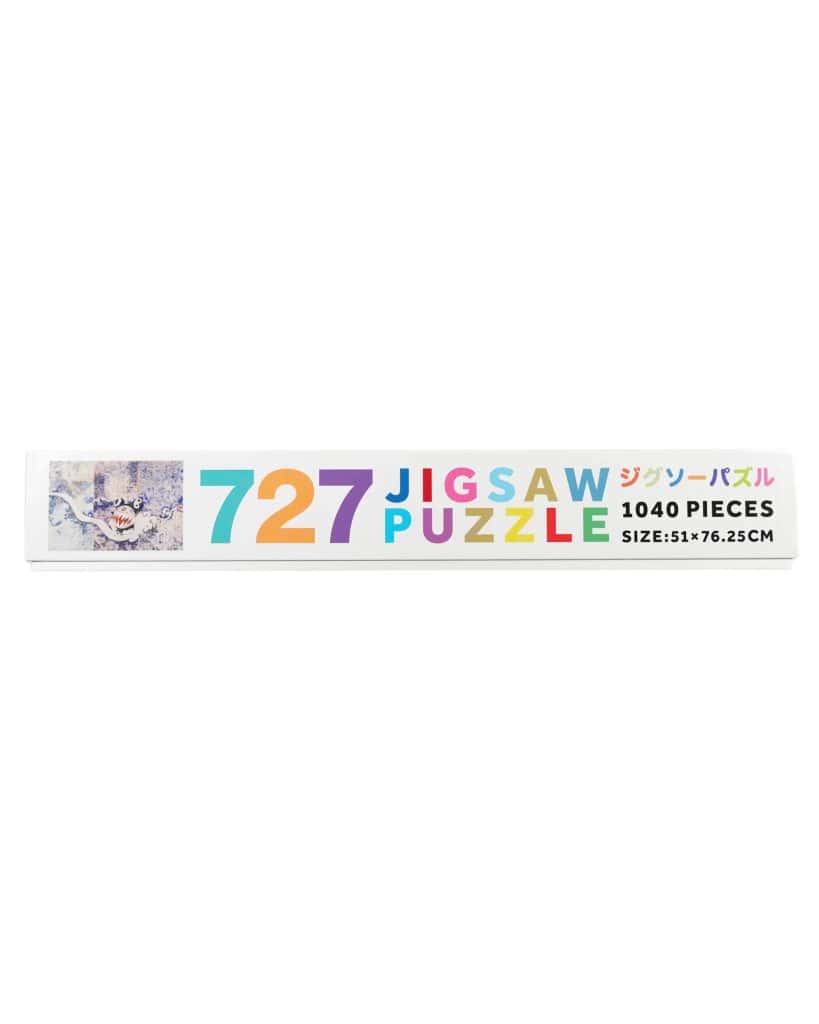
Takashi Murakami – 727 Jigsaw Puzzle
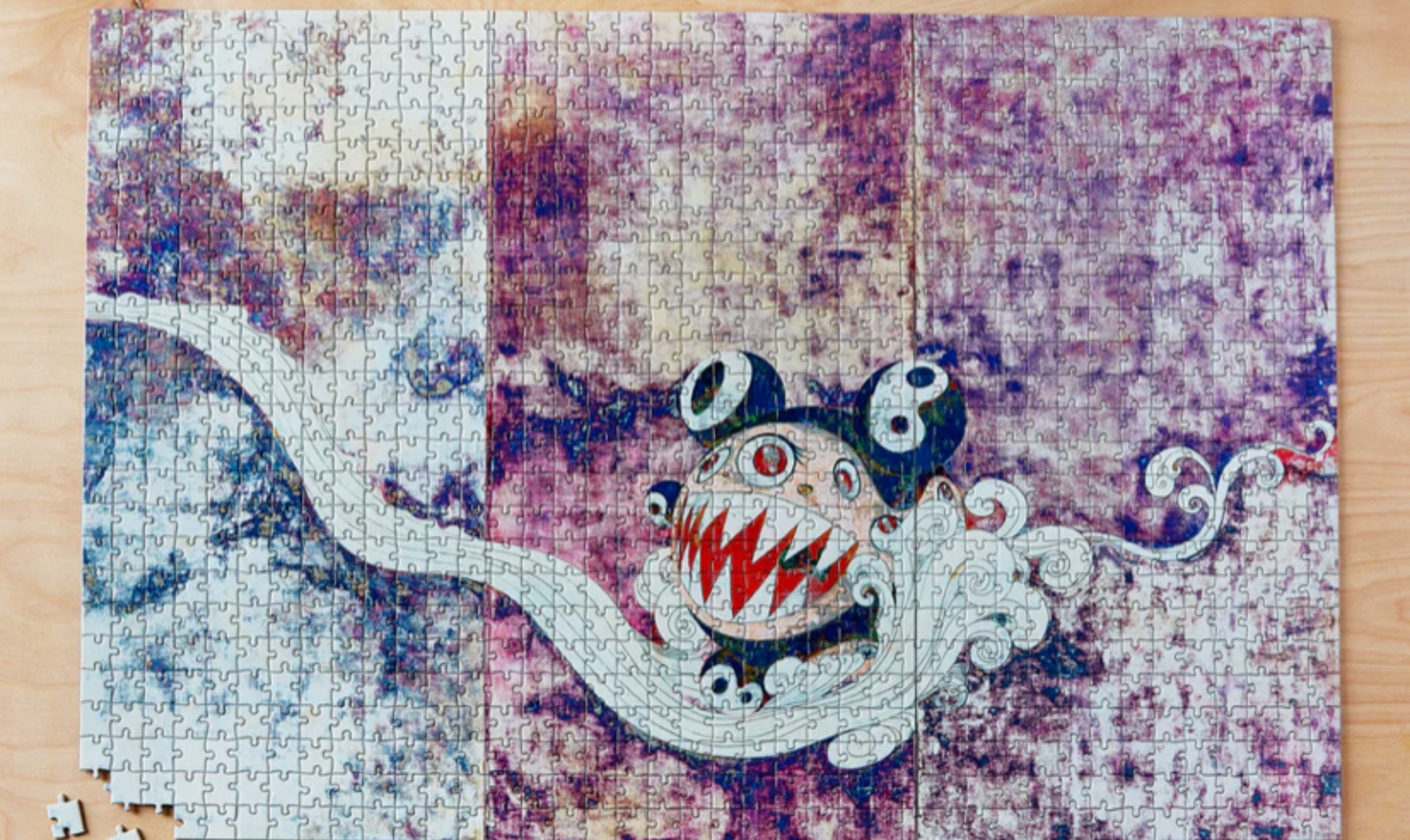
Official Takashi Murakami 727 Jigsaw Puzzle produced by Kaikai Kiki Co., Ltd in 2021. The artwork reproduces Murakami’s iconic “727” painting, featuring Mr. DOB riding a wave of swirling clouds against a textured, weathered background inspired by traditional Japanese byobu screen painting. Printed with non-toxic ink on 95% recycled greyboard.
Before buying any sealed Murakami puzzle, verify five things in sequence: the seal’s integrity, the exact piece count, the edition or publisher, the artwork density, and your own open-or-keep decision. Miss any one of them and you risk overpaying, receiving a repro, or buying a puzzle that frustrates your display plans. These puzzles now trade on the secondary market at real multiples above retail, so due diligence at the point of purchase, not after, is what separates a smart collector from an expensive lesson.
Mistake #1: Skipping the Seal Inspection on a Sealed Murakami Puzzle
First, understand what “factory sealed” actually means for Kaikai Kiki puzzles. The original cellophane wrap sits flush against the box corners with no bubbling, no lifting edges, and no re-wrapped tape lines. Most authentic titles use a single continuous shrink sleeve, not a folded seam or peel-and-stick strip.
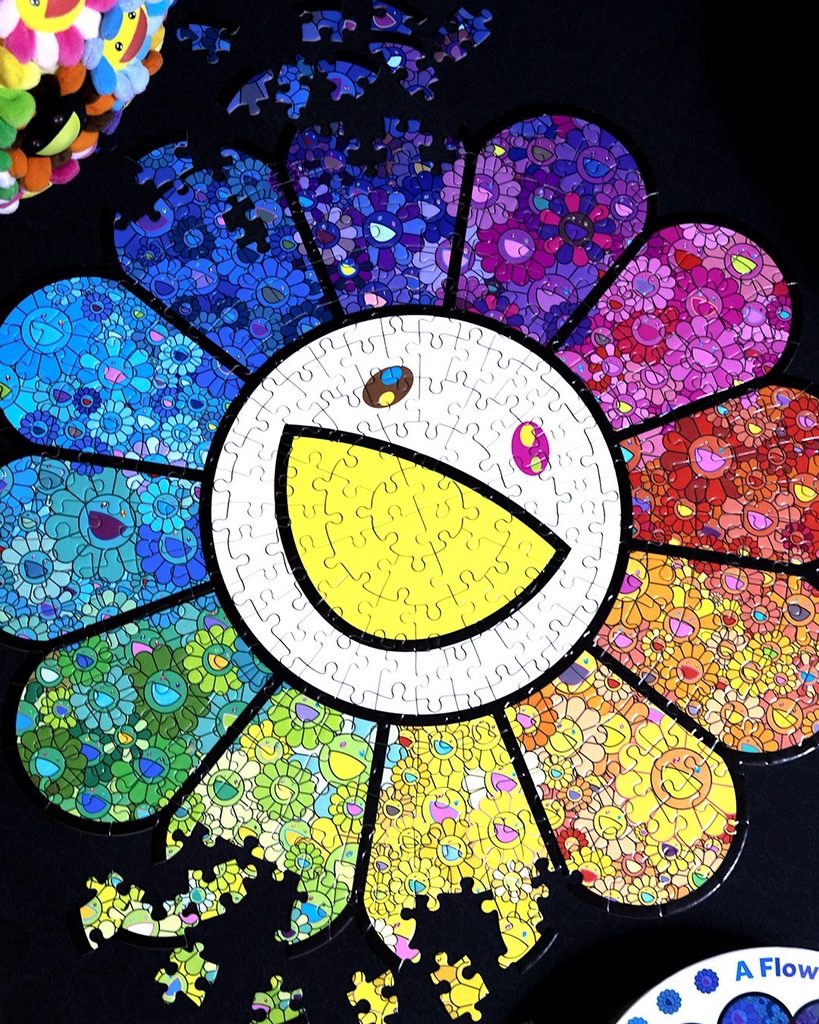
What bad seals actually look like
Rewrapped boxes appear constantly on the secondary market. For instance, a seller relists a puzzle they briefly opened, rewraps it in generic cellophane, and photographs the box at an angle that hides the seam. The dead giveaway is a slightly misaligned wrap that does not hug the spine tightly. Additionally, look for any moisture wrinkling near the corners, which signals the box sat in humid storage and the seal already compromised the cardboard underneath.
Always check the box bottom. Original Kaikai Kiki packaging prints the piece count, a barcode, and Japanese production text directly on the base panel. If that information appears on a sticker rather than the printed card stock, treat it as a red flag. Even so, stickers alone do not disqualify a box. Some legitimate retailer editions add stickers for customs or regional pricing. The key is consistency: sticker plus misaligned wrap plus generic cellophane together signal a problem.
Similarly, photograph the seal before you commit to any purchase from a private seller. Request images of all six sides of the box, not just the front panel. Any reputable seller ships these photos without hesitation. A seller who refuses or claims the light is bad is telling you something important.

Explore the full collection
Figures, art toys & limited editions, shipped across Europe from France.
Mistake #2: Confusing Piece Counts Across Sealed Murakami Puzzle Titles
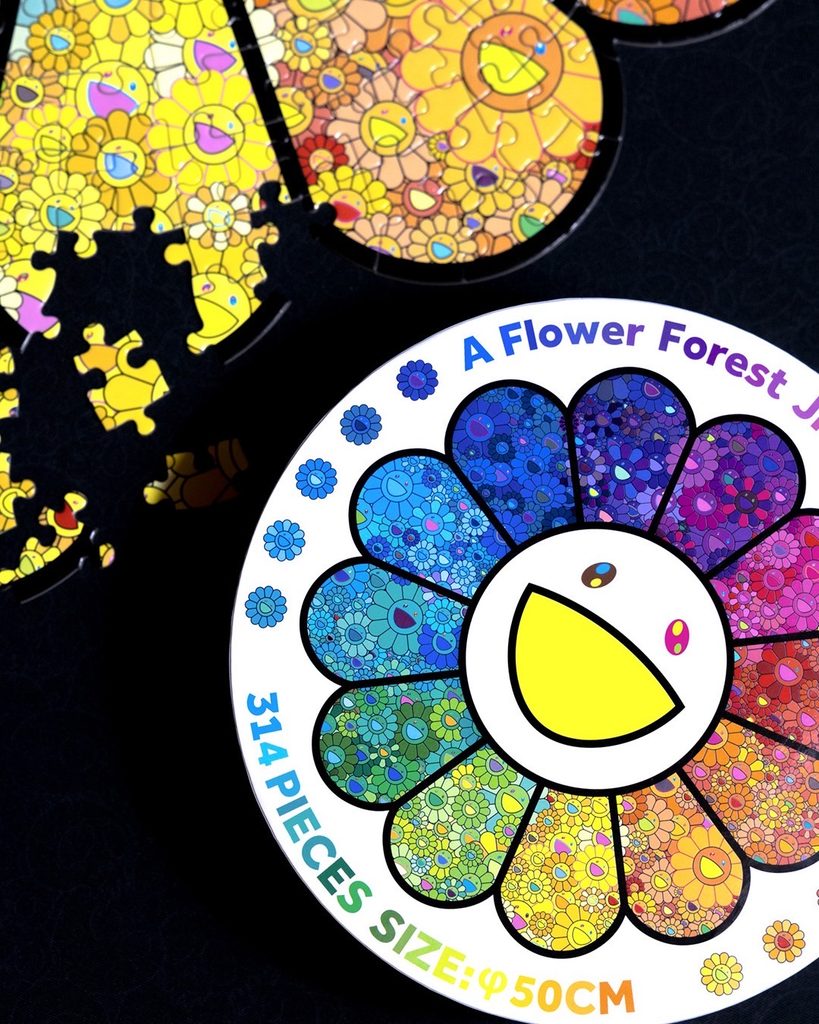
Second, learn the actual counts for the titles you are comparing side by side. This sounds basic. Collectors still get it wrong because Murakami puzzle releases use unconventional counts: 875, 900, 314, 1040. None of them land on the standard 500 or 1000 that mass-market brands use. That is intentional. Kaikai Kiki treats the count as part of the object’s identity, not a manufacturing convenience.
The four titles you are most likely comparing right now
Consider the four core titles currently available. The Isle of the Dead runs 900 pieces and assembles into a dense, maximalist scene. Skulls and Flowers Blue Signal features a repetitive pattern of Murakami’s flower motif intermixed with white skulls, and comprises 875 pieces measuring approximately 26 inches (66 cm) by 20 inches (51 cm). Pandas in the Cherry Orchard uses a similar range. The Flower Forest edition presents a more open, airy composition. These differences matter for display: a 900-piece assembly at standard puzzle dimensions fills a frame differently than an 875-piece one, even when the centimeter measurements look similar on paper.
Therefore, always cross-reference the piece count printed on the box base against the product listing. If those numbers disagree by even one digit, walk away. Beyond that, match the piece count to your framing plan before buying. A puzzle you intend to frame and hang demands a specific assembled dimension, and the wrong count sends you back to the frame shop.
| Title | Piece Count | Publisher | Artwork Character |
|---|---|---|---|
| Isle of the Dead | 900 | Kaikai Kiki / Tonari no Zingaro | Dense, narrative, high complexity |
| Skulls & Flowers Blue Signal | 875 | Kaikai Kiki | Repeating pattern, high contrast |
| Pandas in the Cherry Orchard | Varies by edition | Kaikai Kiki / Zingaro | Floral field, figurative elements |
| Flower Forest | Varies by edition | Kaikai Kiki | Open composition, botanical density |
Mistake #3: Ignoring Which Print Edition the Box Represents
Third, and most costly for collectors who care about long-term value: Murakami puzzle titles see multiple production runs under subtly different publishing partnerships. Kaikai Kiki produces puzzle editions directly, with some released through Tonari no Zingaro. Different runs carry different print credits on the box. In some cases, an early Zingaro-credited box commands a higher secondary price than a later general retail run of the same image, even when the puzzle contents appear identical.
How to read the publisher credit
Locate the producer credit on the box base or rear panel. It reads either “Kaikai Kiki Co., Ltd.” alone, or adds “Tonari no Zingaro” as the retail channel. That credit appears directly on authenticated puzzle packaging. Next, check for a copyright year printed alongside the artwork credit. An earlier copyright date on the same title does not automatically mean a first run, but it narrows your search when cross-referencing with known release timelines. For example, the Skulls and Flowers Blue Signal puzzle released on April 19, 2021. Any copy claiming a pre-2021 production date for that specific title deserves extra scrutiny.
Additionally, with Murakami’s profile rising globally, including Australia’s first major Murakami exhibition arriving at the Art Gallery of NSW, demand for authenticated editions keeps climbing. Because of this, sellers increasingly photograph packaging selectively to obscure edition details. Always ask for a clear photo of the complete rear panel text before committing.
Mistake #4: Not Comparing Artwork Density Across Titles Before Choosing
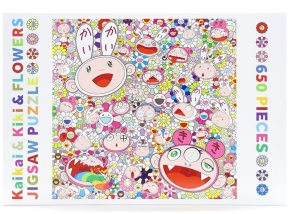
Most importantly, understand what you are buying as art, not just as a collectible format. Murakami puzzles divide into two visual categories: pattern-based and narrative. Pattern-based titles like Skulls and Flowers Blue Signal repeat a motif across the full surface. That puzzle showcases a repetitive pattern intertwining Murakami’s iconic flower motif with striking white skulls. Narrative titles like Isle of the Dead build a single complex scene that reads differently at different scales, adapting one of Murakami’s signature works through colorful and intricate illustration.
Explore the full collection
Figures, art toys & limited editions, shipped across Europe from France.
Pattern versus narrative: which suits your wall
Pattern puzzles assemble faster because repeated elements give your eye constant reference points. However, they display with less visual hierarchy once framed. Narrative puzzles challenge you during assembly but reward you with a richer display. In contrast, pattern titles tend to hold resale value more consistently because the image reads well at thumbnail size in listing photos, which drives secondary demand. Beyond that, consider the color palette in your space. The Blue Signal title sits in a cool blue register. Flower Forest and Pandas titles work in warmer, greener tones. Your wall does not care about edition numbers.
| Title | Visual Type | Assembly Difficulty | Display Impact | Secondary Demand |
|---|---|---|---|---|
| Isle of the Dead (900 pcs) | Narrative | High | Very High | Strong |
| Skulls & Flowers Blue Signal (875 pcs) | Pattern | Medium | High | Very Strong |
| Pandas in the Cherry Orchard | Narrative / Figurative | High | High | Strong |
| Flower Forest | Botanical / Pattern | Medium-High | Medium-High | Moderate-Strong |
Mistake #5: Deciding Open or Sealed Without a Framework
Finally, the question every new collector delays until after they buy: do you open it? The honest answer is that sealed condition adds a measurable premium on the secondary market, but only when the seal itself remains pristine. A bubbled, yellowed, or re-applied seal carries no premium over a cleanly opened and unassembled puzzle. So the real decision is not open-versus-sealed as a binary. Instead, frame it as: can you store this properly sealed long-term, or will conditions degrade the wrap?
A simple open-or-keep decision tree
First, ask whether you have archival storage capacity: a climate-controlled space away from direct light, with stable humidity. If yes, keeping sealed preserves optionality. If no, consider that a degraded seal is worse for resale than a clean open. Second, ask whether this title holds personal meaning you want to experience by assembling. Murakami himself produces these as art objects meant to engage the buyer. Opening is not a collector sin. Third, if you plan to frame and display the assembled work, opening is the only logical path. Above all, decide before you buy, not after. Buyer’s regret rarely improves a sealed box.
Murakami Collectibles at Rare Inventory
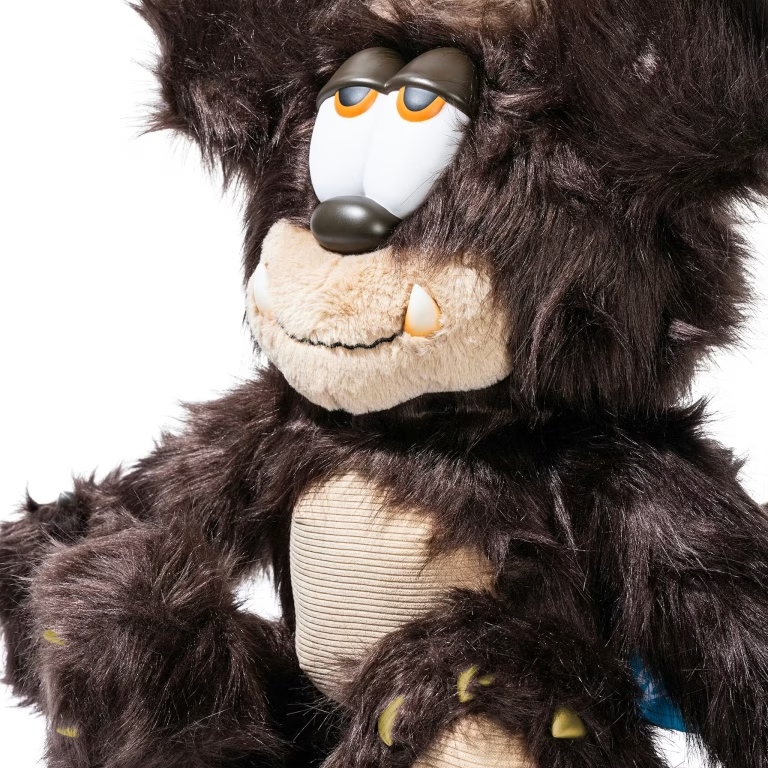
Rare Inventory stocks an expanding range of authenticated Takashi Murakami objects beyond puzzles. For instance, the Louis Vuitton x Takashi Murakami MNNK JP The Wavy Vinyl Sealed Trading Cards (€130) represents the intersection of Murakami’s fine art world with the sealed collectible format this checklist targets. Similarly, the Takashi Murakami x Doraemon Mug Blue Sky (€34) offers an accessible entry into the Murakami collectibles ecosystem. Collectors building broader Murakami shelves should also consider the Takashi Murakami Mononoke Kyoto Thunder God Plush Toy (€19) and the Billie Eilish x Takashi Murakami Flower Logo UT T-Shirt Black (€32) as complementary pieces. All of these are authentic, verified Murakami items currently in stock and ready to ship.
Where to Buy Sealed Murakami Puzzles and Murakami Collectibles
Rare Inventory, based in France, sources and ships authenticated Murakami collectibles across Europe. Browse the current Murakami selection at rareinventory.com, where every item ships with verified provenance documentation. Shipping covers every European country, the UK included, so geography is no barrier to accessing legitimate stock.
Frequently asked questions
Why is Takashi Murakami famous?
Takashi Murakami built his reputation by erasing the line between fine art and commercial culture, a philosophy he calls Superflat. His iconic smiling flowers, DOB character, and skull motifs appear across gallery paintings, Louis Vuitton accessories, and limited collectibles. Additionally, his collaborations with Kanye West on the Graduation album artwork brought his imagery to a global pop audience long before most Western collectors knew his name. His output spans Medicom Toy figures, prints, and the puzzle format covered in this guide, all treated as equally serious extensions of his artistic practice.
Is Takashi Murakami still alive?
Yes. Murakami, born in 1962, remains active and prolific. Recent releases include new silkscreen editions for the Cleveland Museum of Art in 2025, ongoing Kaikai Kiki puzzle production, and a major exhibition scheduled at the Art Gallery of New South Wales in Australia. His studio and retail channel Kaikai Kiki continues to release new collectible formats regularly.
Is Takashi Murakami famous in Japan?
Extremely. Murakami operates Tonari no Zingaro, his Tokyo retail channel, where puzzle drops and limited goods sell out within hours. However, his fame in Japan carries a specific nuance: the fine art establishment took time to fully embrace him, partly because his Superflat movement deliberately challenged the distinction between high and low culture. Today, Japanese collectors treat his puzzle releases as serious collectibles, and secondary market pricing in Japan often leads global trends by several weeks.
What makes a Murakami puzzle different from a standard collector puzzle?
Standard collector puzzles license existing artwork without the artist’s active involvement in production. Murakami puzzles, produced through Kaikai Kiki Co., Ltd., go through his studio’s quality and image approval process directly. Beyond that, the non-standard piece counts (875, 900, 314, 1040) reflect intentional design decisions rather than manufacturing defaults. Most importantly, the publisher credit on the box ties the object directly to Murakami’s controlled production ecosystem, which underpins the secondary market premium these titles command.
The Shop
Available Now at Rare Inventory
Pieces related to this article, in stock and ready to ship.


100% Authentic Shipped from France Free Shipping Over €200