Murakami Doraemon Puzzle 1350 Pieces: What the Collaboration Tells You About Both Artists
Some collaborations reveal more than their surface suggests. The Takashi Murakami x Doraemon 1350-piece puzzle is one of them. On first glance, it reads as licensed merchandise. Look harder, and you find a document of two parallel cultural forces colliding, each amplifying the other’s core argument about what Japanese art can mean globally.
This guide is for collectors who already know the difference between a novelty purchase and a position. We will cover the puzzle’s production context, what the imagery communicates, how condition and completeness affect secondary market value, and why the Japanese domestic market treats this object differently than Western buyers do.
The Two Mythologies in One Box
Takashi Murakami built his career on a single, radical thesis: that otaku culture and fine art occupy the same plane. His Superflat movement rejected the Western hierarchy that places gallery painting above commercial illustration. Doraemon, meanwhile, is the single most recognized character in Japanese cultural export history. The robotic cat from the future first appeared in 1969 and has since become a national symbol of childhood, nostalgia, and technological optimism.
When Murakami applies his visual language to Doraemon, he is not simply decorating a character. He is making an argument. Both entities have always insisted that the line between high and low culture is a construction. The collaboration, therefore, is not a compromise. It is a confirmation.

Explore the full collection
Figures, art toys & limited editions — shipped across Europe from France.
Murakami’s Visual Vocabulary Applied to Doraemon
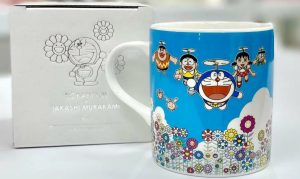
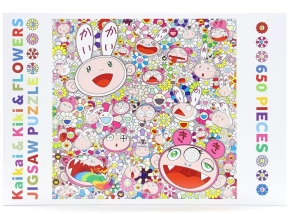
The 1350-piece puzzle features Murakami’s signature flat color fields, repeating floral motifs, and the dense, pattern-heavy compositions he has used across his Louis Vuitton work and his NFT releases. Doraemon appears not as the standard Fujiko F. Fujio character design but filtered through Murakami’s lens: high-saturation, borderless, almost textile-like in its geometry. Additionally, the gold and pink tonal choices reference his Superflat exhibition materials directly. This is not a coincidence. It is editorial control.


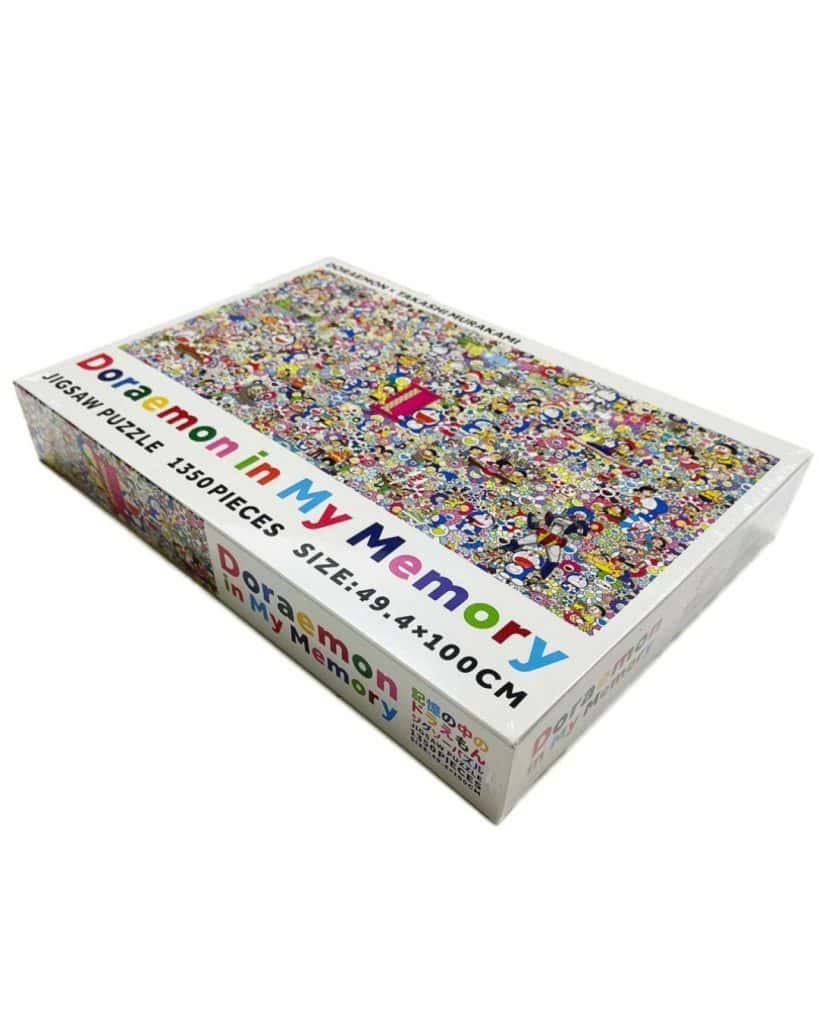
For collectors, the visual coherence matters because it confirms that Murakami’s studio maintained creative authority over the final image. Licensed puzzles where the artist hands off the design tend to read as derivative. This one does not. The compositional decisions are consistent with his museum-grade output.
Production Details Serious Collectors Need to Know
The puzzle was produced in Japan with a piece count of 1350, which is a deliberate choice. Standard collector-tier puzzles run at 1000 pieces. The 1350-piece format signals a premium positioning from the outset. The piece-cut geometry on Japanese-market puzzles, particularly those produced by Ensky and similar licensed manufacturers, uses a tighter interlocking tolerance than most European equivalents. First, this makes the finished image more structurally stable. Second, it supports framing without adhesive, which is relevant if you intend to display rather than store.
Packaging and Sealed Condition
Collectors consistently undervalue packaging on Japanese puzzle releases. However, the secondary market has corrected this over the past three years. A sealed, unplayed example in original shrink wrap commands a significant premium over a completed-and-reboxed version, even when the latter shows no missing pieces. The reason is straightforward: you cannot verify completeness without opening, and the market prices that uncertainty into the sealed example as a positive rather than a negative.

The box itself carries the full Murakami x Doraemon co-branding, including copyright text for both the Kaikai Kiki studio and Fujiko Pro. Both credits must be present on an authentic example. Additionally, the barcode region on Japanese domestic releases differs from any international repackaging. Collectors sourcing from outside Japan should verify which version they hold.
Sealed Japanese-market Murakami x Doraemon puzzles in original shrink wrap have traded at 2x to 3x the retail price on Mercari Japan within 12 months of release, outperforming most standard licensed merchandise in the same category.
Authentication Markers
Counterfeit puzzle products in the Murakami licensing space are less common than counterfeit prints, but they exist. For example, the color calibration on authentic examples is notably precise. Murakami’s studio is known for exacting Pantone fidelity across all licensed output. On counterfeit versions, the gold tones typically shift toward yellow, and the line weight on Doraemon’s face detail becomes inconsistent. Additionally, authentic examples carry a holographic licensing sticker on the base of the box in the Japanese domestic release. Always check for it.
The Japanese Market vs. Western Collector Behavior
Japan treats this object differently than Western collectors do, and the divergence matters for anyone buying or selling across markets.
In Japan, the Murakami x Doraemon collaboration carries deep emotional resonance because both references are native. Doraemon is not an import or an ironic touchstone. It is genuinely sentimental. As a result, Japanese buyers often purchase for personal use first and investment second. This suppresses domestic resale volume and keeps secondary market prices more stable than Western hype cycles typically allow.
Explore the full collection
Figures, art toys & limited editions — shipped across Europe from France.
Western Hype Dynamics
In contrast, Western collectors, particularly those who entered through Murakami’s streetwear and NFT adjacency, treat the puzzle primarily as a Murakami artifact. Doraemon functions as a graphic element rather than an emotional anchor. However, this creates a valuation asymmetry. Western buyers will often pay more per unit than Japanese domestic buyers because they are pricing Murakami scarcity rather than Doraemon accessibility. That asymmetry is your opportunity if you are sourcing from Japan for Western resale, or your risk if you are buying at Western retail expecting Japanese-market appreciation logic to apply.
Meanwhile, PSA does not currently grade puzzles, so the condition grading framework that drives Pokemon card prices does not apply here. The market instead relies on sealed-versus-opened as its primary condition binary, with box condition as a secondary variable. This is more similar to how the market treats Kaws figures or artist-edition board games than how it treats trading cards.
What the Collaboration Signals About Murakami’s Strategy
Murakami has spent the last decade expanding beyond the gallery circuit without abandoning it. His collaborations with Supreme, Billie Eilish, and Virgil Abloh all followed the same logic: use a mass-culture touchstone to introduce Superflat theory to audiences who would never enter a white-cube gallery. The Doraemon puzzle fits this pattern precisely. However, it goes further, because Doraemon is not a trend. The character is a permanent fixture of Japanese cultural identity, which means this collaboration does not expire the way a streetwear drop does.

What It Signals About the Doraemon IP
Fujiko Pro, which manages the Doraemon intellectual property, has historically been conservative with licensing. The studio resisted most high-fashion and contemporary art partnerships for decades. The Murakami collaboration represents a deliberate strategic pivot. Fujiko Pro is signaling that Doraemon can carry contemporary art weight without diluting its core identity. For collectors, this matters because it suggests more premium-tier Doraemon collaborations will follow. First movers in Murakami x Doraemon will benefit from that trajectory.
Additionally, Murakami’s inclusion of Doraemon in his broader visual universe, rather than treating it as an isolated project, indicates ongoing institutional commitment. His studio does not execute one-off licenses casually. The puzzle exists within a larger body of Murakami x Doraemon work that includes prints, apparel, and exhibition materials, all of which reinforce the collectible gravity of each individual object.
Condition, Display, and Long-Term Preservation
If you intend to complete and frame the puzzle, use a UV-filtering acrylic frame rather than standard glass. Murakami’s color palette, particularly the high-saturation pinks and the metallic gold passages, fades faster under UV exposure than more muted compositions. Japanese puzzle paper stock is generally acid-free, but the pigment layer on the print surface is not archival by default. Frame it sealed and stored away from direct light, and the image will hold for decades. Expose it to a south-facing window, and you will see color shift within three years.
Storage for Sealed Examples
For sealed examples held as collectibles, store horizontally rather than vertically. Vertical storage over time causes the puzzle pieces to settle and compress against the interior packaging in ways that can create visible indentations through the box face. Additionally, maintain storage at consistent humidity. Japanese cardboard stock responds poorly to high-humidity environments, and the box warping that results will meaningfully reduce secondary market value. Use a plastic sleeve over the exterior box if long-term sealed storage is your plan.
| Condition Tier | Description | Market Impact |
|---|---|---|
| Factory Sealed, Original Shrink | Unplayed, original wrap intact, no box damage | Maximum premium, 2x to 3x retail typical |
| Sealed, No Shrink | Unplayed but shrink removed, box pristine | Moderate premium, 1.3x to 1.8x retail |
| Completed, All Pieces Present | Assembled and reboxed, verified complete | Near retail, premium for display-ready framing |
| Incomplete or Box Damage | Missing pieces or significant box wear | Below retail, parts or display value only |
| Market | Primary Buyer Profile | Valuation Driver | Resale Volatility |
|---|---|---|---|
| Japan (Domestic) | Doraemon fan and Murakami collector overlap | Emotional + artistic value equally weighted | Low, stable appreciation |
| Western Markets | Murakami-first collectors, streetwear adjacents | Murakami scarcity premium dominant | Higher, trend-sensitive |
| Southeast Asia | Mixed, strong Doraemon cultural resonance | Character IP value plus artist premium | Moderate, growing |
Rare Inventory Recommends
Collector Recommendation: Buy sealed, store horizontal, and hold for at least 24 months before evaluating resale. The Murakami x Doraemon collaboration is not a quick flip. It is a position in two converging cultural vectors, and the secondary market will price that convergence more accurately as the broader Murakami estate strategy becomes clearer over the next few years. Prioritize Japanese domestic sourcing when possible. The price differential versus Western retail is still meaningful, and the authenticity risk is substantially lower.
Where to Buy the Murakami Doraemon Puzzle 1350 Pieces
Rare Inventory carries authenticated collectible puzzles and Murakami-adjacent pieces, with shipping across Europe from France. For collectors outside Japan, buying from an authenticated source removes the primary risk in this category: receiving a counterfeit or a resealed open example misrepresented as factory sealed. Browse current stock at rareinventory.com/shop for available Murakami and Japanese collectible inventory.

Frequently asked questions
Is the Murakami Doraemon puzzle a limited edition release?
Fujiko Pro and Kaikai Kiki did not publicly announce a numbered edition size, which is consistent with how most Japanese licensed puzzle releases operate. However, production runs on premium collaboration puzzles of this tier are typically short, and secondary market prices confirm that supply has not kept pace with collector demand. Treat it as effectively limited even without an official edition number.
Does the puzzle have any formal grading or authentication system like PSA?
PSA does not currently grade puzzles. Authentication relies on physical inspection: holographic licensing sticker, color fidelity, copyright credit block on the box, and barcode verification for the Japanese domestic version. Sealed examples with original shrink wrap are the closest equivalent to a graded slab in terms of market confidence, because they eliminate completeness uncertainty entirely.
How does this puzzle fit into Murakami’s broader collectible hierarchy?
Murakami produces work across a wide price spectrum, from museum prints in the six-figure range to accessible licensed products. The Doraemon puzzle sits firmly in the accessible tier, but it references the same visual language as his gallery output. For new collectors, it functions as a low-barrier entry point into the Murakami ecosystem with genuine appreciation potential. For established collectors, it is a lateral hold alongside more capital-intensive positions in his print and sculpture market.
What is the difference between the Japanese domestic version and any international release?
The Japanese domestic version carries Fujiko Pro and Kaikai Kiki dual copyright credits, a specific Japanese-market barcode, and in most cases the holographic licensing sticker on the box base. International versions, where they exist, may omit some of these markers. The Japanese domestic version is the primary collector target. Additionally, the color printing standards on Japanese-market examples are consistently tighter, which matters for a Murakami product where Pantone fidelity is part of the artwork’s integrity.
The Shop
Available Now at Rare Inventory
Pieces related to this article, in stock and ready to ship.


100% Authentic Shipped from France Free Shipping Over €200